Chapter 01Before Belmont was Belmont, it was a swamp.
The land at the foot of the Laventille Hills was, until the middle of the nineteenth century, the drainage system of Port of Spain. Streams ran off the heights, gathered on the flat, and made their way to the Gulf of Paria. It was malarial and mostly uninhabited. The Spanish, who had held Trinidad since 1498, had never quite bothered to plant on it. Neither did the French planters who arrived by decree of the Spanish Crown in 1783 to shore up the population; they went south to the cane land in Naparima and left the swamp alone.
When the British took the island by force in 1797, they inherited a small capital of about 3,000 people, an economy of cocoa and coffee, and a body of enslaved Africans held on sugar and cocoa estates in the plains south of the Northern Range. The city was Port of Spain, and it sat at the harbour. What would become Belmont sat behind it, half a mile inland, invisible.
By 1834, when the British Slavery Abolition Act took effect across the empire, the capital had grown, the swamp had drained, and the land at the foot of the hills was suddenly a piece of empty real estate close to a city. What happened next is the reason we're here.
Chapter 02The 1840s: ships that never landed.
Between 1807, when Britain outlawed the transatlantic slave trade, and 1867, when the trade finally ended in fact rather than law, the Royal Navy patrolled the Atlantic intercepting the ships of other nations that were still moving enslaved Africans westward. When a captured slave ship was condemned in the Vice-Admiralty court at Sierra Leone or elsewhere, its human cargo was declared "liberated" — a technical status meaning legally free but not yet delivered anywhere.
Between 1841 and 1861, the British delivered roughly 8,854 of these "liberated Africans" to Trinidad. They arrived in small ships, in small groups, often speaking languages no one on the island understood. The colonial government, having nowhere obvious to put them and needing labour for the estates, assigned them to indentured contracts on plantations for a period of years. Some went south to cane. Some stayed near the capital.
Those who stayed in Port of Spain, or drifted back to it after their indenture ended, found the empty flat land east of the city. It was cheap, it was near wage-labour, and — for the first time in three centuries — no one owned the people on it. They built.
“They came out of ships that were never meant to reach a shore, and built the first Black-owned neighbourhood in the Western Hemisphere.”— Carl Campbell, historian, on the 1850s Belmont settlement
Chapter 03The Rada community and the Yoruba compound.
Among the liberated Africans landed at Trinidad in the 1850s and 1860s were groups who arrived cohesively enough to keep the languages, religions, and social structures of the West African societies they had been taken from. Two communities in particular put down roots in what would become Belmont: the Rada (Fon-speaking people from present-day Benin) and the Yoruba (from present-day Nigeria).
The Rada compound on Belmont Circular Road, established around 1868 by a priest named Abojevi Zahwenu (known locally as Robert Antoine), was for over a century the centre of Vodun practice in the country. Ceremonies were public, drums were played into the night, and neighbours of every background attended. The compound survived until the 1990s. A plaque now marks the site.
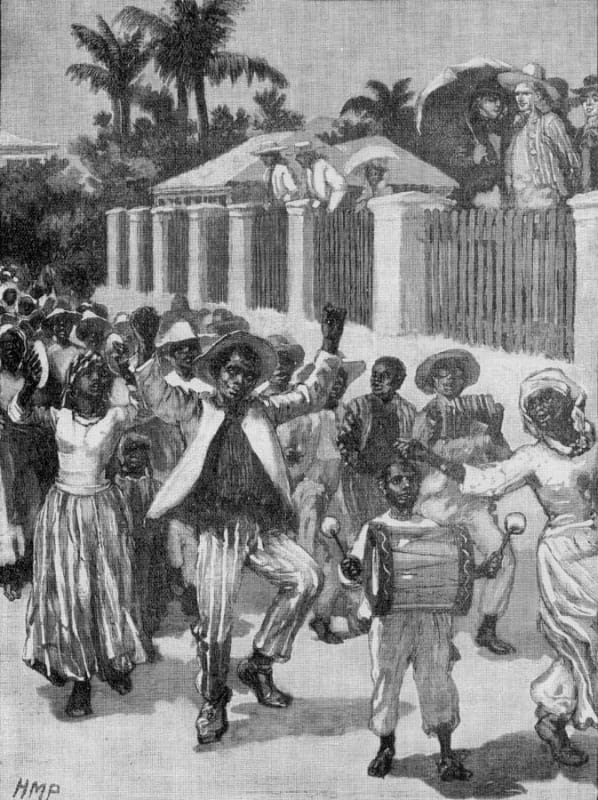
The Yoruba, arriving in slightly larger numbers, established their own compound further up the hill and their own set of orisha practices. They also brought the drum patterns, the vocal call-and-response, and the physical vocabulary of street procession that would, four generations later, become Trinidad Carnival.
What the Rada compound left us
The Yoruba word obeah and Fon-derived spiritual practice both entered the general vocabulary and imagination of the country from Belmont. Local words for family, for food, for street directions retain Fon and Yoruba roots. The annual Orisha festivals held in Trinidad today can be traced back to the compounds of Belmont in the 1870s.
Chapter 04The Black St. Clair, 1880 to 1920.
By the 1880s Belmont was no longer a swamp with a few compounds; it was a neighbourhood. The characteristic street pattern — narrow, winding lanes that follow the old drainage courses — was set in place by that decade. The population swelled: nine thousand people by 1900, a mix of the descendants of the liberated Africans, freed enslaved people from the estates, and a growing Black professional class who worked in the city but were locked out of the richer suburbs to the west by an unwritten but strictly enforced colour bar.
St. Clair, Woodbrook, Maraval — the suburbs to the west and north-west — were white. Belmont, at the foot of the hill, became the neighbourhood of the Black professional class: doctors, teachers, journalists, civil servants, jurists. They built the large gingerbread houses that still line the Circular Road, with their ornate fretwork trim, tall louvered shutters, and wraparound verandahs; the whole architectural vernacular you see when you walk here.
Belmont became known as "the Black St. Clair," a nickname carried without irony, a statement of what was possible and what was pointedly denied elsewhere. The neighbourhood produced, within a generation, four of the Republic's Presidents, two Prime Ministers, and — improbable but true — the woman who would found the Notting Hill Carnival in London.
Chapter 05The invention of the steel pan, a nation in a drum.
In 1884, the British colonial government, alarmed at the political potential of African drumming in a majority-Black colony, passed the Music Ordinance banning skin drums, tamboo bamboo, and any percussion that could be construed as "African." The ban held for decades. What it produced, however, was not silence.
Musicians switched to what wasn't banned. First, they hit bamboo — tamboo bamboo. When that was regulated, they hit biscuit tins. When that was scorned, they hit dustbin lids. And in the yards of Belmont and neighbouring John John, in the late 1930s, a group of young men began beating discarded oil drums with pieces of broken pipe. They discovered that the drums, if dented correctly, could be tuned. And if tuned in sections, they could be melodic. And melody was not banned.
The first tuned steel pan was played publicly in Trinidad in 1938. Its principal inventor — one of several, in truth, though the credit is his — was Ellie Mannette, then a teenager, working out of a yard on the Belmont side of the ridge. He wrapped the sticks in rubber. He hammered the concave (later convex) surface. He named the notes.
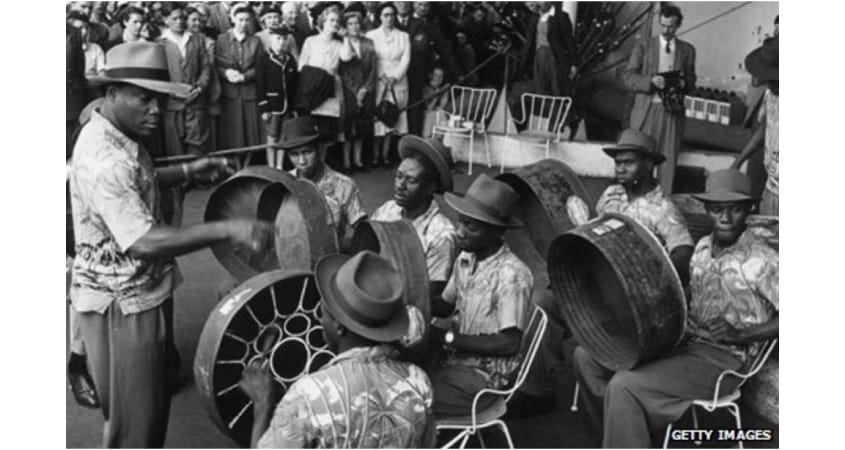
Within twenty years, the steel band had gone from a Belmont yard invention to the national instrument. Within thirty, it was played in London, Toronto, New York. The Panorama competition, held annually on the Saturday before Carnival on the Queen's Park Savannah, is now the world's largest steel band contest. Ten of the top twelve competing bands rehearse in Belmont or on the Laventille slope directly behind it.
“They banned the drum. We invented a new one out of what they had thrown away.”— Attributed to Winston "Spree" Simon, early panman
Chapter 06Carnival and the mas camp, a workshop economy.
Trinidad Carnival, staged annually in the two days before Ash Wednesday, is the largest and oldest Carnival in the Caribbean. It runs on a workshop economy — the mas camp — that is, more than anywhere else in the country, concentrated in Belmont.
A mas camp is a warehouse or house yard converted, from about November until Carnival, into a full-scale costume factory. Wire, feathers, sequins, glue, headdresses six feet high. The costume designs are drawn by a mas man (or woman); the labour is done by dozens of neighbourhood workers on piece rates. In Belmont in the 1960s and 70s, Peter Minshall — the mas designer whose work has been staged at three Olympic Games — worked out of a camp on St. Vincent Street, five minutes from our gate.
The oldest continuously operating mas camp in the country, the Silver Stars' camp on Newbold Street, has been building costumes for Carnival every year since 1964. During the eleven months of the year that are not Carnival, Belmont's mas camps are quiet. In November they begin humming. By late January they are the busiest workspaces in the country.
Chapter 07Six Belmontians, and why the world remembers them.
Belmont is a small neighbourhood — roughly a mile square, nine thousand residents at the last census. It has produced, per capita, more people of national and international consequence than any other neighbourhood in the Republic. Below are six, chosen from a longer list, whose lives began in Belmont and whose work carried it outward.
Kwame Ture
Chapter 08Belmont today, the neighbourhood as living archive.
Belmont in the 2020s is what most colonial suburbs turn into, and one thing they rarely do. It is a working middle-income neighbourhood: the professionals are still here, but so are the tradesmen, the taxi drivers, the doubles vendors, the pan tuners. Gentrification, when it comes to Port of Spain, mostly goes to Woodbrook and Newtown; Belmont has been passed over, which the people who live here consider a blessing.
What is unusual is the density of history per square metre. You can walk from the Rada compound plaque to the birthplace of the country's first President to the yard where Ellie Mannette bent his first pan to the mas camp where Peter Minshall built his last king, all inside twenty minutes on foot. Most of these houses are still lived in by descendants of the families who built them.
The National Trust of Trinidad and Tobago has designated Belmont a "conservation area" since 2005. In practice this means very little; enforcement is thin. In fact, what protects the neighbourhood is the people. They know what they have. They watch what changes.
We opened The Sanctuary at 128 Belmont Circular Road in 2018, in a gingerbread building of the 1890s that had been in the same family for four generations. Our job, as we understand it, is to keep it the way it has always been, and to introduce it — one room at a time — to the people who come to see it.
“Belmont is the country's living archive. The gingerbread is not a museum. The people are not exhibits. Come, walk, and be polite.”— House note, printed on the counter of every room