A ring of buildings and a bowl of grass, seven minutes from our gate

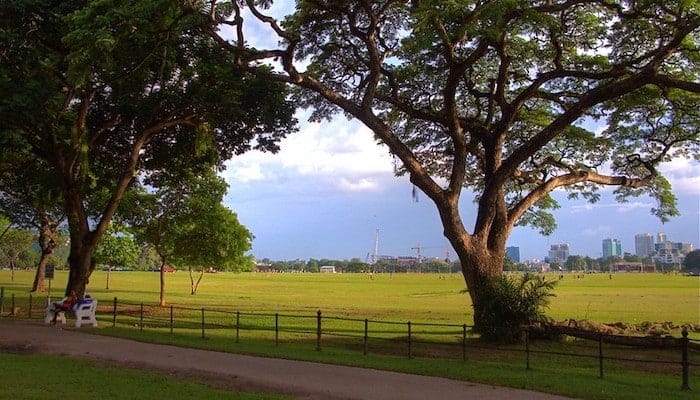
Queen's Park Savannah, and the buildings that ring it.

Two-and-a-quarter miles of grass, a colonial-era racecourse turned public commons, and along its western edge the seven wooden mansions Trinidadians grew up calling the Magnificent Seven. Everything on this page is within a fifteen-minute walk of The Sanctuary.

Est. 1817 · public commons Written for our guests · 12 minute read
The Savannah, in one sentence

A 260-acre commons that is Port of Spain's front room.

The Savannah is the largest open space in the city and, if you believe the guidebooks, the largest roundabout in the world. Both are true. What matters more is that it is where Port of Spain goes to walk in the evening, to fly a kite on a Sunday, to eat corn soup out of a paper cup, and to watch, twice a year, Carnival either arrive or leave.

It sits at the top of the city like a green shield. Downtown falls away to the south. Belmont, our neighbourhood, tucks in against its eastern flank. The old hills of St. Ann's rise to the north. The western edge is where the country's most photographed row of buildings sits — a string of colonial-era mansions built in the last decade of the nineteenth century by the men who owned cocoa and sugar, and later handed over, one by one, to schools, embassies and the state.

Everything on this page , the Magnificent Seven, the Zoo, the Botanic Gardens, NAPA, the President's House, the War Memorial, the coconut vendors, the joggers who lap the grass at 5.30am , sits inside a 2.2 mile loop. From our black gate, the nearest edge of the Savannah is a seven-minute walk downhill. You will hear it before you see it.

Size
260 ac
Roughly the same footprint as London's Hyde Park
Loop distance
3.7 km
One full circuit along the pavement
From our gate
7 min
Downhill on foot to the eastern edge
Established
1817
Public commons since Governor Woodford
The Magnificent Seven

Seven houses. One block.

Between 1902 and 1910, seven mansions were built shoulder-to-shoulder along Maraval Road, the western edge of the Savannah. Some were private homes for cocoa planters. Some were institutional from the start. All seven are still standing. Not all are open, but all can be walked past in twenty minutes, in order, north to south. Bring a hat.

01

Queen's Royal College

Built 1904 German Renaissance Working school

The northernmost of the seven, and the only one that has never changed use. QRC is still one of Trinidad's best-known boys' schools; V.S. Naipaul, Eric Williams and Nobel laureate Derek Walcott (who taught here briefly) are all connected to it. The blue trim, the clock tower, and the fine German-Renaissance masonry are original.

You cannot go inside during term time, but the front lawn and the perimeter are public. Cricket is often being played somewhere on the grounds. It is the most photographable of the seven from the pavement.
02

Hayes Court

Built 1910 French provincial Anglican residence

The official residence of the Anglican bishop of Trinidad and Tobago. Named for Bishop Thomas Hayes, and built in a comparatively restrained French-provincial style beside its more flamboyant neighbours. Private residence, not open to the public, but the front garden reads well from the pavement.

03

Mille Fleurs

Built 1904 French Second Empire Under restoration

Built by Dr. Enrique Prada, a former mayor of Port of Spain, in French Second Empire style. The fretwork, mansard roof and cast-iron balconies are the most delicate of the seven, and the reason so many Trinidadian wedding photographs use this stretch of Maraval Road as a backdrop.

After decades of neglect Mille Fleurs is in phased restoration; you may see scaffolding. Even under scaffolding it is worth the walk.

04

Roomor (Ambard's House)

Built 1904 French Baroque Private

The most photographed of them all: a wedding cake of blue-and-white French Baroque with three storeys of turrets, dormers, cast-iron cresting and a slate mansard roof. Built for the French Creole cocoa planter Lucien Ambard and long owned by the Roodal family (hence “Roomor”). Still a private residence.

If you have time for only one photograph on Maraval Road, take it here, from the pavement across the street, in the last hour before sunset. The light lands.

05

Archbishop's Palace

Built 1904 Irish Romanesque Catholic residence

The residence of the Roman Catholic Archbishop of Port of Spain. Built by Irish architect Robert Neville in Irish-Romanesque style: heavier, squarer, more monastic than its French neighbours. The stone is imported from Barbados. Not open to visitors, but the driveway is often used for Corpus Christi processions and Easter blessings.

06

White Hall

Built 1904 Moorish Mediterranean Office of the Prime Minister

The white one. Built by cocoa planter Joseph Leon Agostini in a self-consciously Mediterranean-Moorish style, with a distinctive corner tower and lime-washed stucco. Later requisitioned by the US Army during World War II, and now the Office of the Prime Minister of Trinidad and Tobago. You will see the security detail before you see the house.

Do not photograph the guards. Photograph the building.

07

Stollmeyer's Castle (Killarney)

Built 1904 Scottish Baronial Occasional tours

The southernmost of the seven, and the one that most looks like a castle because it is one: a working replica of Balmoral built by German-Trinidadian planter Charles Stollmeyer, who wanted his wife to feel at home. Turrets, crenellations, wrought-iron gates, and a full suit of armour reputedly still inside.

Now government-owned and occasionally opened for guided tours (roughly once a month; check the Office of the Prime Minister's cultural calendar). If a tour is running while you are here, take it — the interior is the only one of the seven the public gets to see.

The North edge

Two institutions share the top of the Savannah.

At the northern end of the loop, on either side of a single gate, sit the Emperor Valley Zoo and the Royal Botanic Gardens. The two are contiguous, they share a history that goes back to the 1820s, and you can walk from one into the other on the same afternoon.

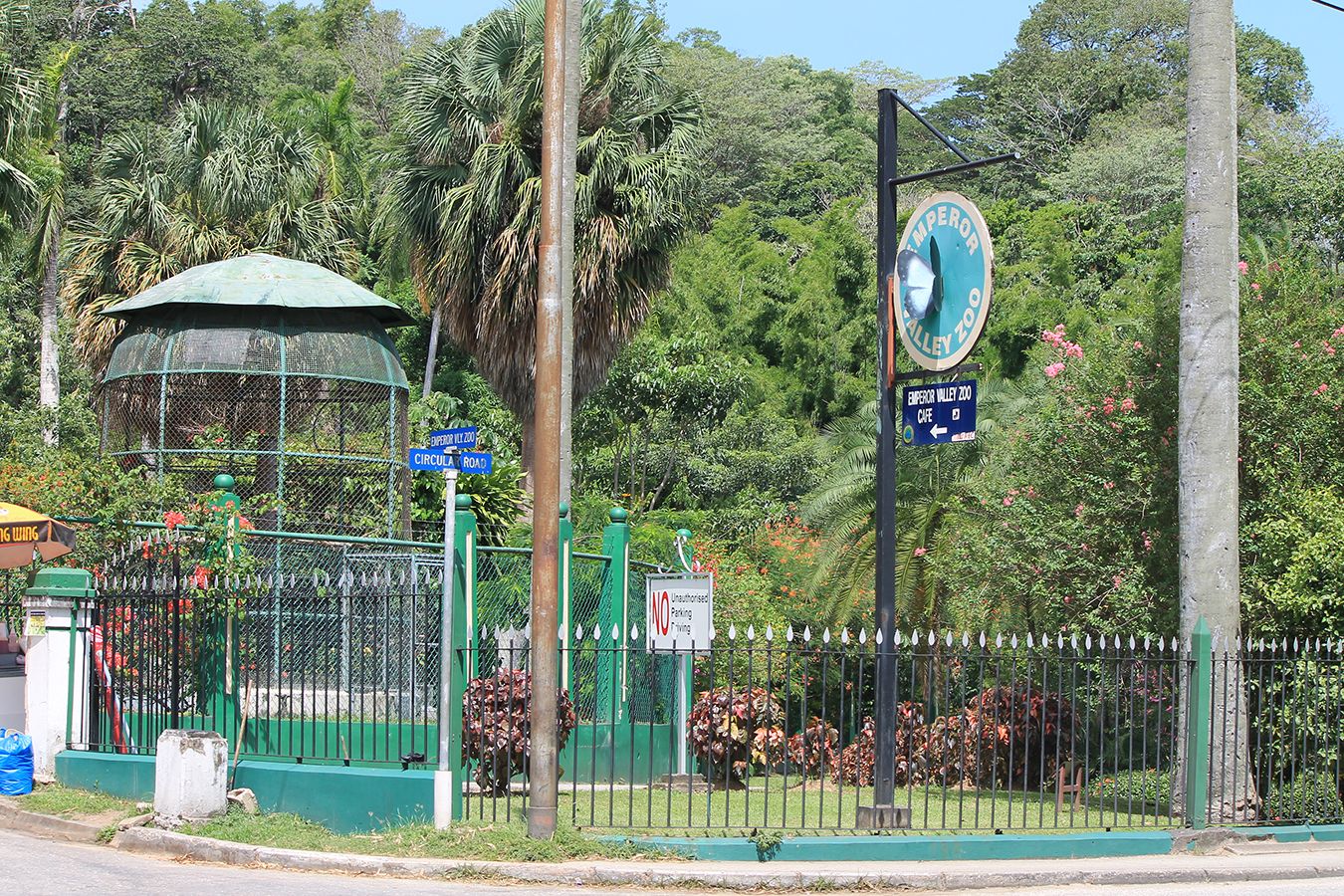
Emperor Valley Zoo, Port of Spain
Emperor Valley Zoo

Trinidad's national zoo, eight acres of Caribbean fauna.

Opened in 1952 on the grounds of an old cocoa estate called Emperor Valley (for the emperor butterflies that used to swarm the property), the zoo focuses heavily on Caribbean and South American wildlife: ocelots, red howler monkeys, scarlet ibis, capybaras, caimans, boa constrictors, and a walk-through aviary of Neotropical parrots.

It is modest by international standards, and better for it. Two hours is plenty. The Sanctuary is fifteen minutes' walk from the entrance.

8am to 6pmDaily
TT$20 / TT$10Adult / child
2 hrsTypical visit
15 minWalk from us
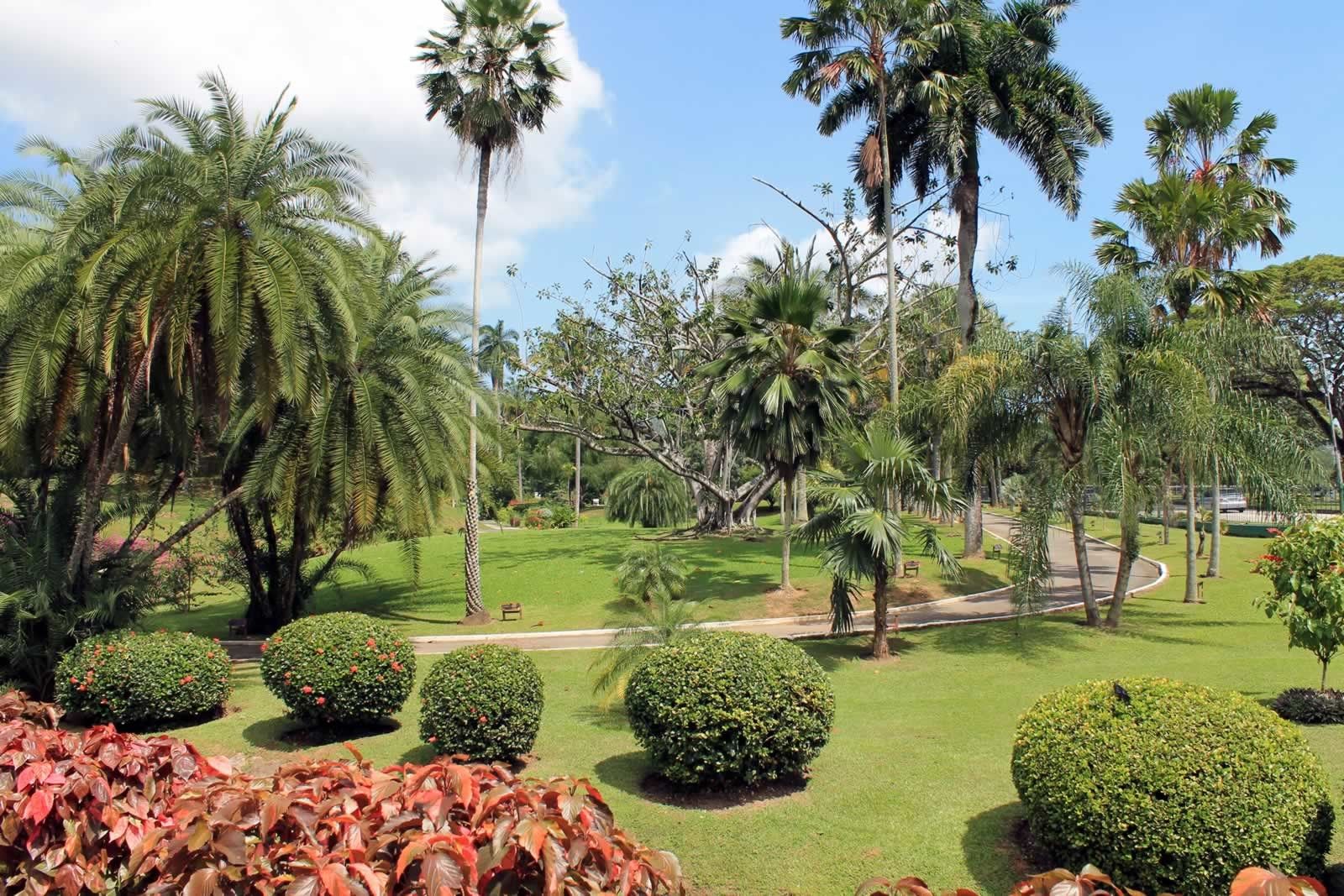
Royal Botanic Gardens, Port of Spain
Royal Botanic Gardens

Sixty-two acres of specimen trees, free, and open at dawn.

Laid out in 1818 by Sir Ralph Woodford as one of the oldest botanical gardens in the Western Hemisphere. Sixty-two acres, more than seven hundred species of tree (many labelled, in Latin, on discreet metal plaques), a formal sunken lawn, and the President's House sitting inside the grounds as a bonus.

Free of charge. Best in the first hour after sunrise, when the joggers have not arrived and the fruit-bats are still coming home. Bring a book.

6am to 6pmDaily
FreeNo admission
62 acresWoodford, 1818
700+ speciesMany labelled
Continue to Belmont
Three landmarks on the ring road

A theatre, a residence, and a memorial.

Three more buildings sit on the loop and deserve to be picked out. One is the most modern building on the Savannah. One is the oldest. One is deliberately quiet, and asks you to be quiet with it.

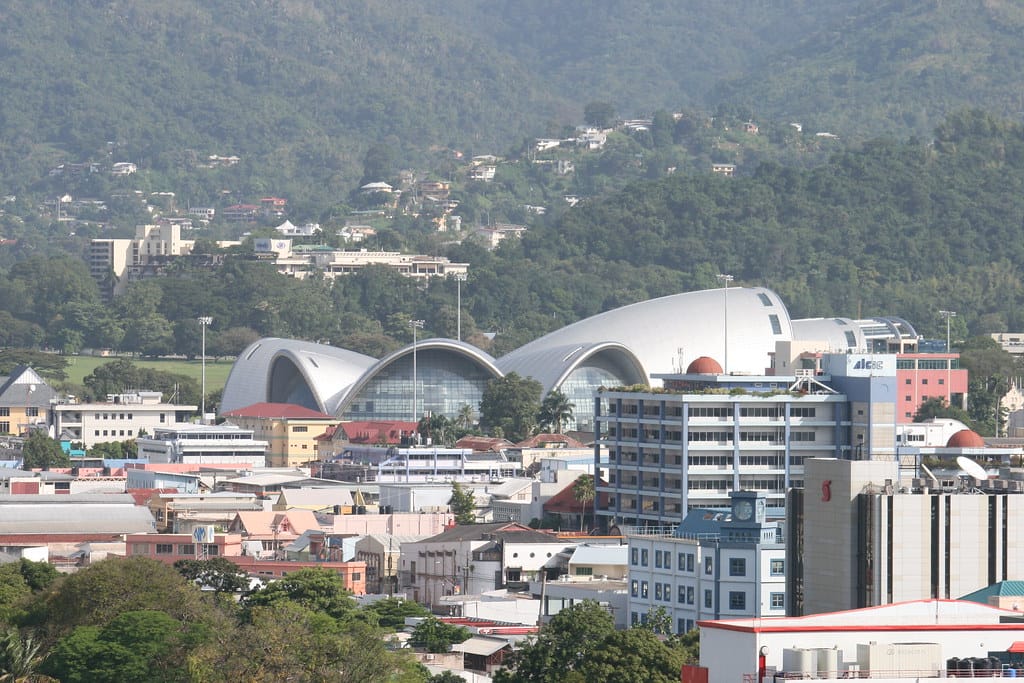
The National Academy for the Performing Arts (NAPA), Port of Spain
NAPA

The National Academy for the Performing Arts.

On the south-eastern corner of the Savannah, opened in 2009, a folded shell of white steel and glass by Shanghai Construction Group. It is meant to echo the shape of a chaconia flower, Trinidad's national bloom — the eye takes a moment to arrive at the reference and then it lands.

Home to the National Philharmonic Orchestra and a rotating programme of local theatre, dance, and Carnival competitions. Panorama semi-finals for the Small Bands category are often held here. Box office opens 90 minutes before showtime; walking from us is fifteen minutes flat.

2009Completed
1,500 seatsMain hall
ChaconiaDesign reference
15 minWalk from us
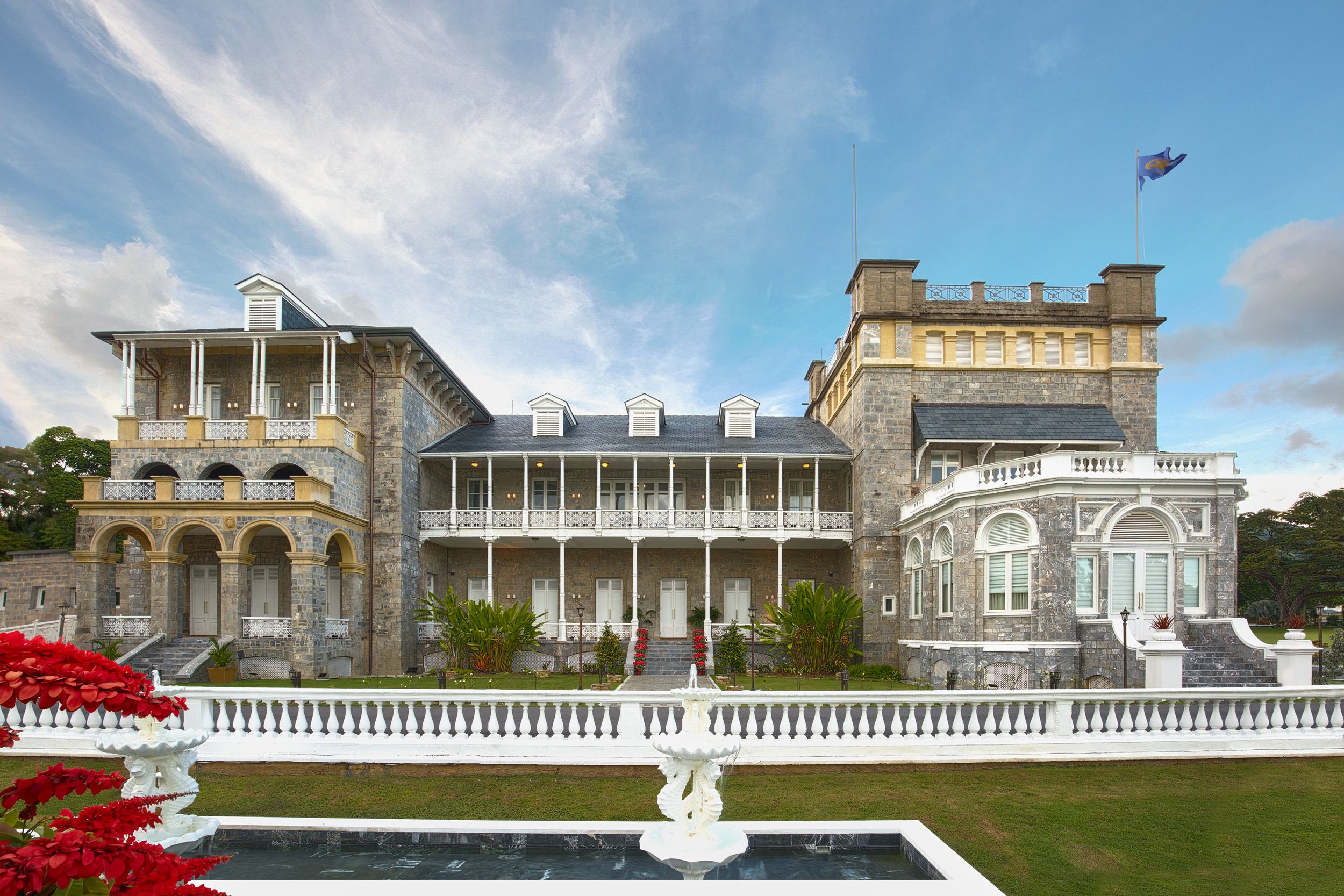
The President's House, Port of Spain
The President's House

The oldest building on the Savannah, still in use.

Built between 1873 and 1876 as Government House, in Renaissance-revival style, for the British governor of the colony. Since 1976 it has been the official residence of the President of the Republic of Trinidad and Tobago.

Set inside the Botanic Gardens on the northern edge, hidden behind a stand of Cannonball trees and reachable by a driveway you cannot walk up. The best view is from the loop road on a clear morning — look up through the gap between the two large Saman trees. It is worth the pause.

1873 - 76Built
FergusonArchitect (Scottish)
Since 1976Presidential residence
Not openGrounds only
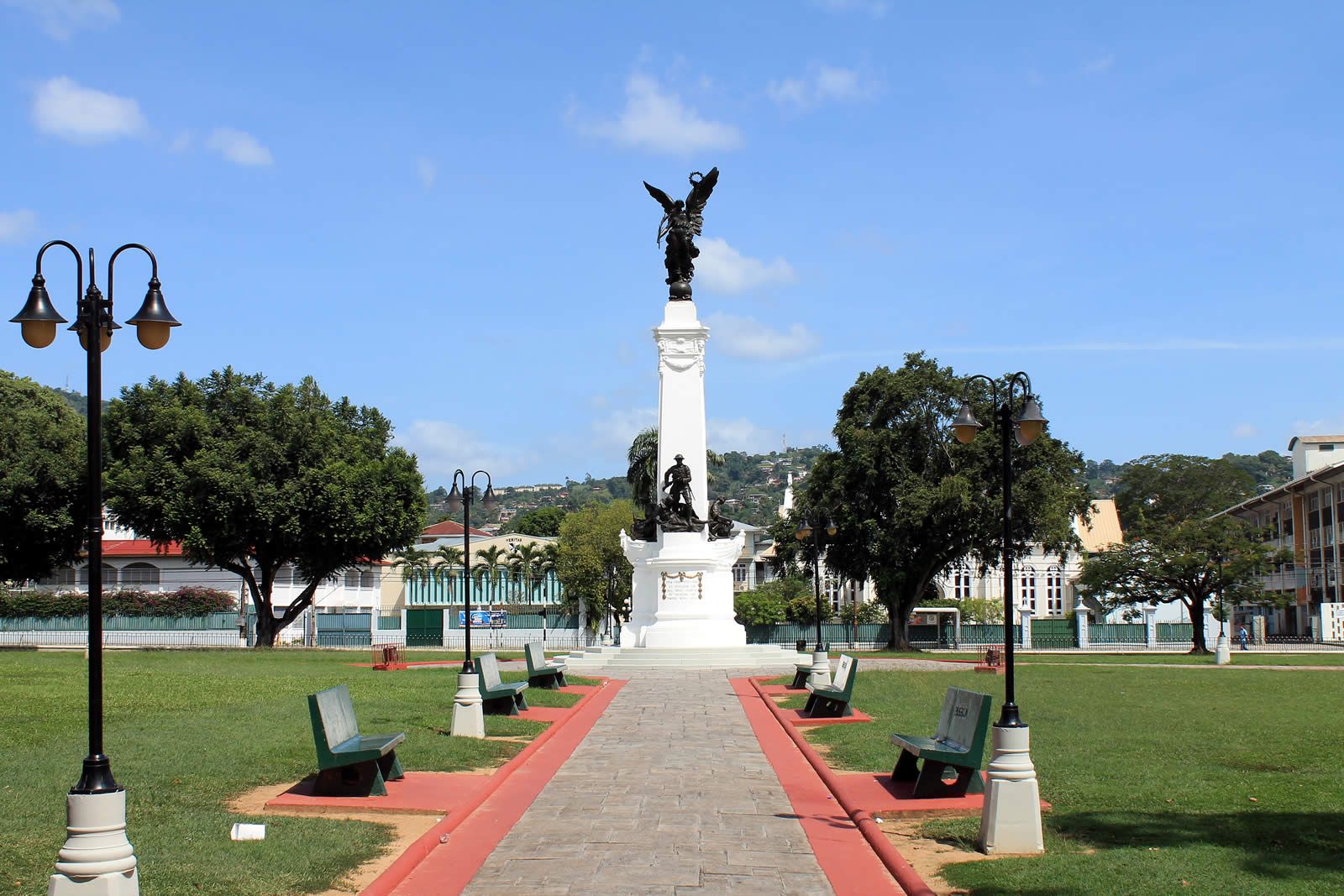
The Cenotaph in Memorial Park, Port of Spain
Memorial Park & the Cenotaph

A quiet square, with three obligations.

Tucked into the south-east corner of the Savannah beside NAPA, Memorial Park is the smaller of the two national parks in central Port of Spain. It holds the Cenotaph, unveiled in 1924 for the Trinidadian dead of the First World War, and later expanded for the Second.

Twice a year the park fills: on Remembrance Sunday in November (poppies, bugles, a full military parade) and on Emancipation Day in August (drumming, African dress, and a procession that ends at the Treasury Building downtown). The other 363 days it is one of the quietest places in the city. Benches. Shade. Not much else. Perfect for a book.

1924Cenotaph unveiled
Nov 11Remembrance Sunday
Aug 1Emancipation Day
Always openPublic park
The Village

What actually happens on the grass.

The buildings are the theory. The Savannah's real subject is the people who use it every day: the vendors, the joggers, the school football teams, the Sunday kite-flyers, the four-in-the-morning drum circle that only assembles during Carnival season. Any of these is worth an hour.

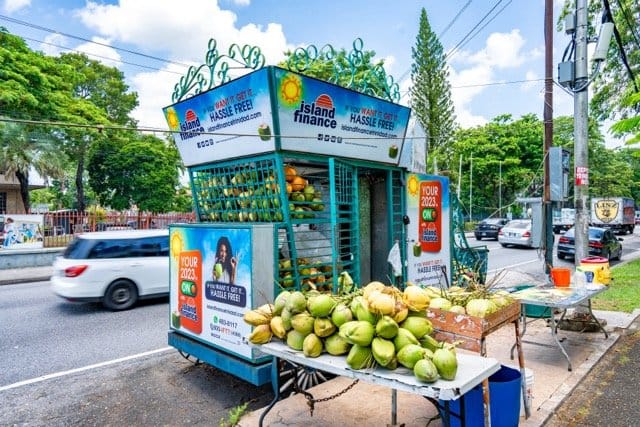
Coconut vendor on the Savannah perimeter
Corn soup & coconuts

The vendors on the perimeter.

A permanent circuit of small carts and canopies runs along the southern and eastern edges of the Savannah from mid-afternoon into the night. Corn soup, roast corn, fresh coconut water (the vendor will hand you the machete cut so you can drink it standing up), oysters in a peppery brine, doubles until about 10am and roti until about 4pm.

  • Coconut waterTT$10
  • Corn soupTT$15
  • DoublesTT$7 · morning
  • Bake & sharkSunday · south side
Runners on the Queen's Park Savannah loop
The 5.30am loop

Joggers, walkers, and the fitness clubs.

The Savannah loop is a 3.7km pavement circuit, mostly flat, well-lit before dawn, and safe. A rotating cast of running clubs meets on the western edge Monday, Wednesday and Saturday mornings from 5.30am. Newcomers are welcome to fall in at the back. Bring water; the vendors are not open yet.

  • 3.7 kmFull loop
  • 5.30am startMon · Wed · Sat
  • Flat, pavedStreetlights on
  • WaterBring your own
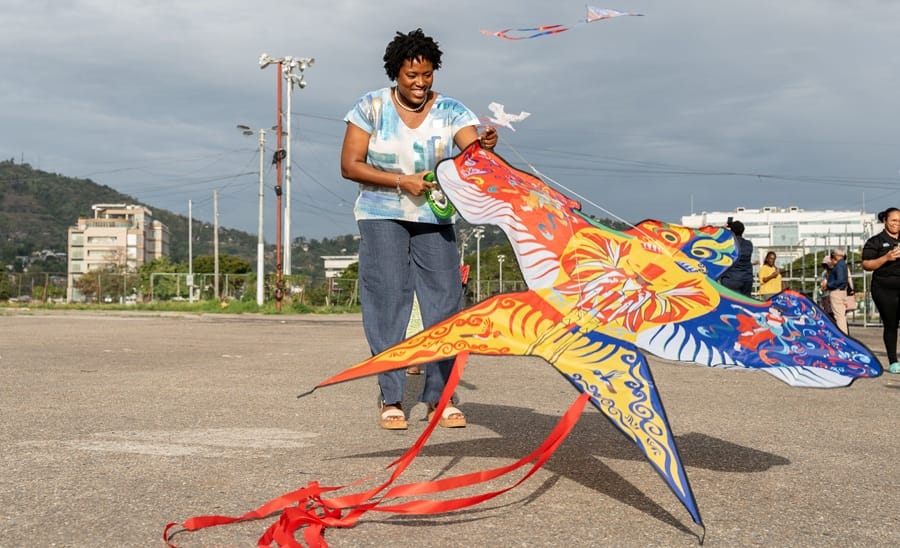
Kite flying at Queen's Park Savannah
On the grass

Football, cricket, kites and Carnival.

The interior of the Savannah is one enormous open field, laid out for informal sport. Cricket on Saturday afternoons, football on Sundays, kite flying every windy day in April and May. During Carnival season the northern third turns into the Grand Stand, where the mas bands cross the stage on Carnival Monday and Tuesday and where Panorama finals are held.

  • CricketSat afternoons
  • FootballSun · all day
  • Kite seasonApr - May
  • PanoramaSat before Carnival
Logistics

Walking the loop, counter-clockwise, from us.

A comfortable evening walk from The Sanctuary that covers everything on this page in about 90 minutes. Wear a hat. Take water. Start at 5pm; you'll finish as the vendors are lighting their lamps.

START · Belmont Zoo & Gardens Magnificent Seven NAPA & Memorial Park N
  1. 0:00 Walk out of the black gate, downhill on Belmont Circular Rd. Cross Circular Rd. East at the Savannah's eastern edge. 7 min
  2. 0:07 Enter the loop road. Turn right (counter-clockwise) — you'll pass the Grand Stand and Memorial Park on your left. NAPA
  3. 0:20 South-west corner. Cross Tragarete Rd. and you are at the foot of Maraval Road, with Stollmeyer's Castle rising on the right. Seven
  4. 0:35 Work your way north up Maraval Road: Whitehall, Archbishop's, Roomor, Mille Fleurs, Hayes Court, Queen's Royal College. Photos
  5. 0:55 Turn right at the top and enter the Botanic Gardens through the main gate. The President's House will be through the trees on your left. Gardens
  6. 1:15 Exit the Gardens on the eastern side and walk south down the loop road. Coconut vendors will be setting up on your right. Coconuts
  7. 1:30 Cross back to Belmont at the eastern edge; uphill on Circular Rd. to our gate. Dinner on Ariapita Ave. or a shower and a rest. Home
Related, on this site
The neighbourhood

Belmont — our home ground.

The oldest suburb of Port of Spain, and the neighbourhood that built the steel pan.

The culture

Pan yards & Carnival.

Five rehearsal yards within walking distance. Every Panorama, they open.

The island

Explore Trinidad.

Beyond the Savannah: beaches, rainforest, waterfalls, and the sister island.

Stay seven minutes from the loop.